Rethinking Food Waste: Seeing Value Before It Becomes Waste

Food waste is often discussed as a problem that begins at the bin. But what if the more important conversation starts much earlier?
On the launch of Warga Jakarta Bijak Pangan, organised by the Indonesia Business Council for Sustainable Development (IBCSD) through its GRASP (Gotong Royong Atasi Susut & Sisa Pangan) 2030 initiative, Senang Eco saw how prevention can shift the way we think about food waste. Running from July to October 2026, the campaign focuses on reducing food waste at the source and encouraging shared responsibility across households and communities (22/07/2026).
Senang Eco’s Sustainability Consultant, Fikria Maharani, attended the launch and came away with an important reflection: ingredients that are often overlooked can still hold value.
“Organic materials we often see as having little value, such as watermelon and carrot peels, can be repurposed as ingredients to add flavour or garnish,” she shared. “Rethinking ‘waste’ can unlock value before it reaches the waste stream.”
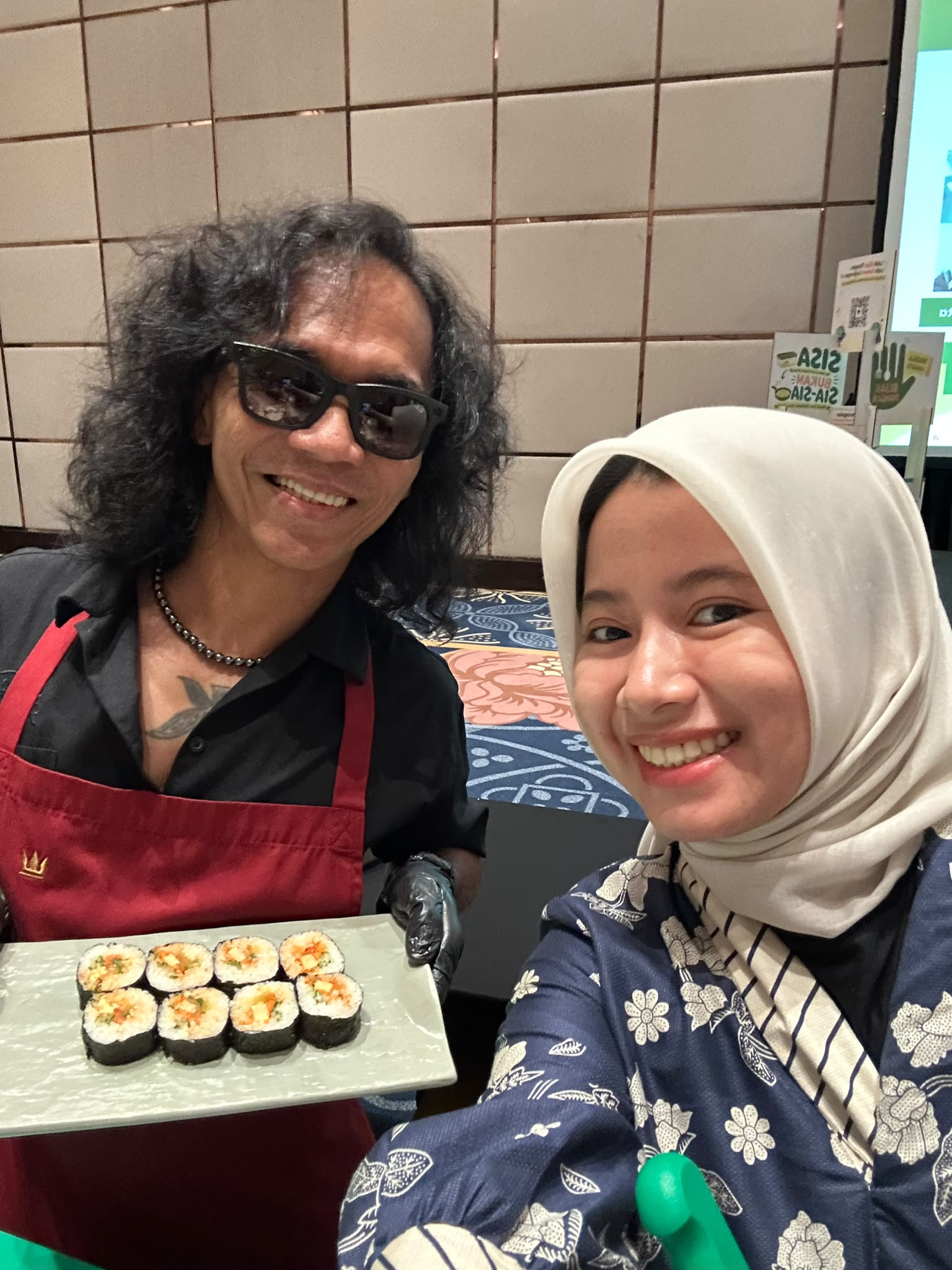
Fikria Maharani, Sustainability Consultant at Senang Eco, learning how to turn overlooked food ingredients into something valuable alongside Kaka Slank at the Warga Jakarta Bijak Pangan launch.
The example may seem simple, but it points to a bigger opportunity. Food waste does not only happen when something reaches the bin. It can begin with how we purchase, prepare, serve, store, and consume food.
This matters in a city like Jakarta, where waste generation exceeds 7,300 tonnes per day, with around half consisting of organic waste. Tackling this challenge therefore requires more than better collection and disposal. It requires looking upstream and asking why certain materials become waste in the first place.
The same thinking can apply to businesses. A pilot at Fairmont Jakarta, highlighted during the event, reportedly reduced food waste by 25%, from 314 g to 237 g, with annual savings estimated at 34 tonnes of food, 101 tonnes of CO₂e, and USD 216,000.
For Senang Eco, the conversation reinforces an important principle: waste prevention is not simply about managing waste better. It is about redesigning systems so less waste is created in the first place.
As Fikria’s reflection suggests, sometimes the shift starts with simply seeing value where we once saw waste. A more circular food system starts before the bin, with the choices we make, the value we recognise, and the systems we design.